Read the route as a network
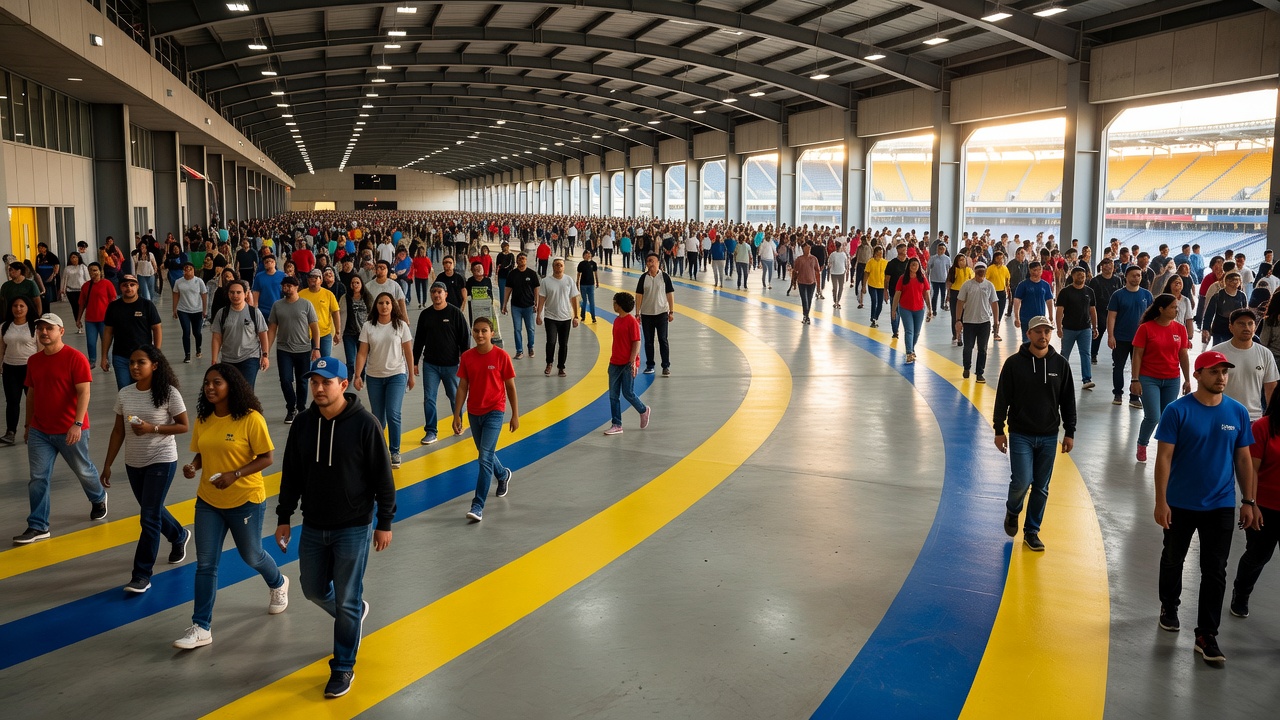
Stadium circulation can be understood as a network of spaces joined by decision points. Entrances feed concourses; concourses connect to stairs, ramps, seating blocks, toilets, food outlets and exits. Narrow passages and junctions can become sensitive when several streams meet. A route that looks direct on a floor plan may be confusing on event day if sightlines are poor, signs appear late or a queue occupies part of the walkway.
Start by defining the destination and the people expected to travel there. “Move spectators to the exit” is less actionable than “direct section 112 visitors toward the west approach while keeping the cross-concourse access open.” Specify whether the trip is for arrival, a facility visit, evacuation planning or a temporary diversion. The purpose changes which routes are available and what staff must communicate. Plans should account for accessible paths and avoid assuming every visitor can use stairs or move at the same pace.
Number branches before messaging them
- Origin and destination.
Identify who is being directed, from where, and to which clear destination. - Route candidates.
List the preferred path and a usable alternative, including access features and restrictions. - Conflict check.
Look for crossing flows, queue spillback, opposing movement and pinch points. - Field confirmation.
Ask staff to verify the path remains open before publishing or announcing it.
Every branch needs an owner. A digital map can suggest a route, but it cannot always detect a barrier, a spill or an unplanned work area. The person responsible for a diversion should confirm the route with colleagues positioned along it, then tell the control desk what changed. Without confirmation, several channels may send people in different directions.
Anticipate conflicting movement
Movement is often bidirectional. People heading to seats meet visitors returning from concessions; outgoing spectators cross circulation toward accessible facilities; a queue may form where a concourse narrows. A routing plan should therefore consider the interaction between flows, not just the volume travelling toward one destination. Where possible, separate streams spatially or in time. If separation is not workable, use visible staff positions, concise wayfinding and a plan to pause or meter movement when a crossing becomes difficult.
Do not treat a density estimate as a complete description of comfort or risk. The geometry of the space, speed, direction, behaviour and duration all matter. A small group can create a blocked doorway; a larger moving stream may pass through a broad concourse without stopping. Sensor outputs can help identify a change, but field staff should be able to report where people are slowing, stopping or turning back. Describe the location and observed condition rather than relying only on an abstract “high” label.
Make directions easy to follow
Good instructions are short, consistent and specific. Name a recognizable destination, then say which side, level or gate to use. Use the same terminology in signs, public-address announcements, apps and staff briefings. Provide information before the visitor reaches the junction; a sign placed directly at a split may leave too little time to choose. If directions change, remove or cover stale instructions and identify which message is current.
Wayfinding has to work for people who cannot hear an announcement, read a small screen or move quickly. Use legible contrast and repeat information through more than one appropriate channel. Keep accessible routes clearly identified and staffed when conditions demand it. Avoid sending people back through a crowded area simply because a device’s shortest-path calculation favours that option.
Routing under changing conditions
Establish in advance what can trigger a route review: a closed passage, incident response, queue growth, a sensor anomaly, weather impact or a steward report. Define who approves a change and who communicates it. A route may need temporary closure, but closure can push movement to another junction; check neighbouring spaces before acting. Update staff first or in a coordinated sequence so they can support the transition. Record the time, reason, approving role and observed effect.
Test plans through walkthroughs and tabletop scenarios. Try a blocked primary route, an inaccessible lift, a delayed alert and a surge in opposite-direction traffic. These exercises reveal missing decision points and unclear language. After an event, ask whether visitors found the route, where they hesitated, how long a diversion remained in place and whether it created a new conflict. Revise the map with the people who worked the route, not only from a central office view.
References: UK Health and Safety Executive, Managing crowds safely; FIFA, Stadium Safety and Security Regulations; ISO 22320:2018. Route examples here are conceptual, not venue instructions.