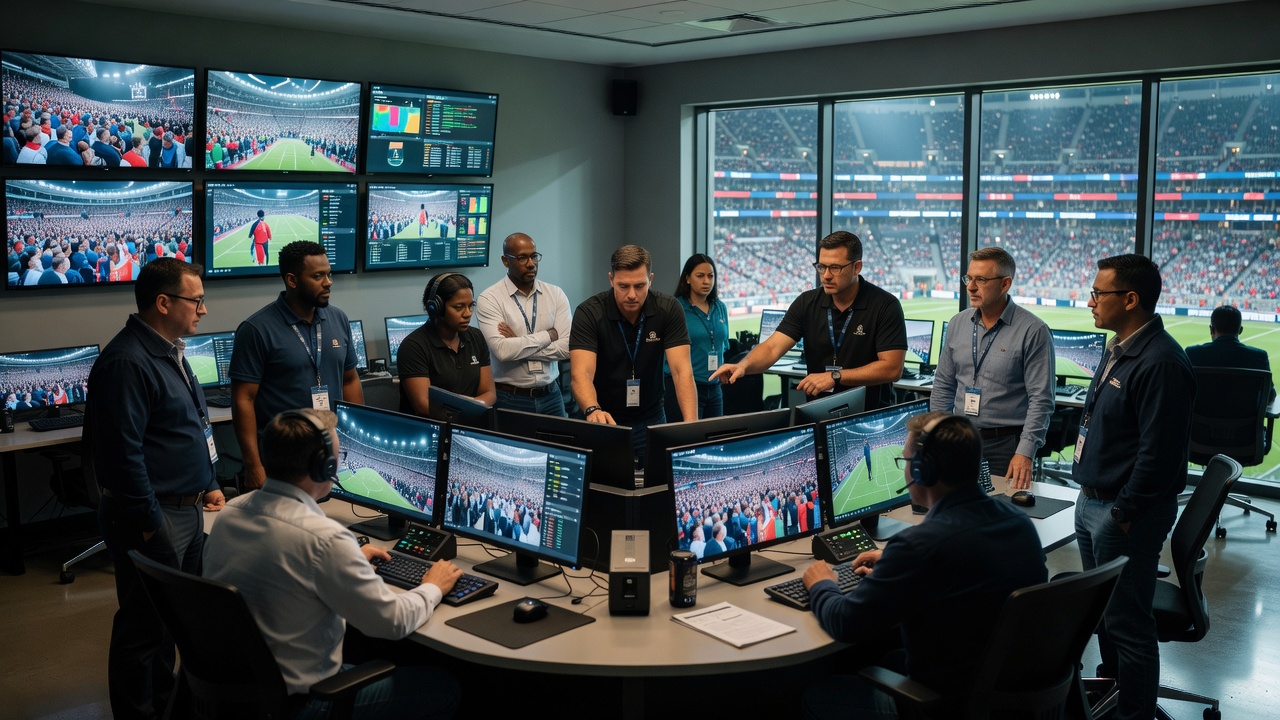
Set up for decisions, not display volume
An event control desk is useful when it helps a team understand what is happening, decide who should act and confirm whether the action had the intended effect. It can combine steward reports, radio messages, ticketing information, occupancy estimates, camera observations, medical updates and venue status. Those inputs differ in reliability, speed and coverage. A neat screen does not make them equivalent.
Before an event, establish roles and escalation authority. Identify who owns each operational area, who maintains the shared picture, who can approve a route change or pause an entry flow, and who communicates with external partners. Name a deputy for critical roles. Write down how to reach each other if the primary radio channel, network or dashboard is unavailable. A role chart that nobody has rehearsed is not a dependable fallback.
Event-phase checklist
- Before opening: confirm staffing, channels, contact paths, access arrangements, signs, status boards and fallback procedures.
- Arrival: monitor queue edges and crossings; compare system estimates with field reports; assign an owner to discrepancies.
- During the event: review planned movements and facility peaks; log restrictions, incidents and route changes with timestamps.
- Departure: coordinate exit information, transport updates and accessible options; monitor the effect of phased release plans.
- After close: check that visitors have cleared public-facing areas, account for unresolved reports and preserve the event record appropriately.
Use a consistent report
Short messages are easier to act on under pressure. A useful format is: location, observation, time, impact, request. “North concourse, queue reaching the stair landing, observed at 18:42, crossing partly obstructed; request a supervisor check” carries more actionable detail than “North side busy.” Where possible, state whether a report is directly observed, estimated from a system or relayed by another person. Confirm that the recipient understood the request and name who will follow up.
A dashboard should show timestamp, zone, source and data quality alongside a value. A missing feed must look different from a quiet area. If a data stream is delayed, label it as stale rather than allowing an old figure to look current. When sensors disagree, the control team should not hide the discrepancy by presenting an unexplained average. Preserve the disagreement and direct someone to check the area.
Give alerts an owner and a next step
An alert threshold is a prompt to assess a condition, not a self-executing declaration. Thresholds need local validation and context. If a queue reaches a marked boundary, one possible action may be a steward check; another may be a temporary change to arrivals. The appropriate choice depends on the full scene, the available space, the event phase and the authority assigned to the role. Do not let an automated message silently change public instructions or control access without a defined human process.
Escalation paths should be clear enough that staff do not need to guess whether to report a medical concern, suspected obstruction, equipment failure or unusual crowd behaviour. Record who acknowledged an escalation and what action followed. Where multiple organizations share responsibility, agree the handover process before event day. Separate the emergency response plan from routine operating guidance, and ensure event staff know how to access the relevant plan.
Coordinate channels
Radio, public-address announcements, digital signs, staff briefings and visitor-facing apps can all carry information. If they use different language, visitors may receive contradictory directions. Keep a central source of current instructions and give the message owner authority to update each channel. A change should reach field teams in time for them to support it. Remove outdated signs or messages where practical, and tell staff how to identify a superseded instruction.
Communication should account for people who may not hear, see or understand a single channel. Provide clear, plain-language directions, use consistent place names and consider accessible formats. Avoid broadcasting unverified estimates as fact. If uncertainty remains, state what is known, what is being checked and when the next update is expected. A controlled, honest update is preferable to unwarranted certainty.
Learn from the record
After the event, review a timeline that combines significant observations and decisions. Ask whether information arrived early enough, whether the right person received it, and whether the response changed the condition. Compare planned assumptions with observed conditions, while noting relevant differences in attendance, weather, transport and event schedule. Keep only records needed for operational learning, accountability or another defined purpose, and apply appropriate access controls and retention practices.
Include frontline staff in the review. They can explain why a planned lane was difficult to supervise, how visitors interpreted a sign or why a junction remained blocked despite apparently normal sensor figures. Translate lessons into changes with an owner and a check date. Rehearse the updated process before relying on it in a higher-pressure event.
References: ISO 22320:2018, Security and resilience—Emergency management; UK Health and Safety Executive, Managing crowds safely; FIFA, Stadium Safety and Security Regulations.