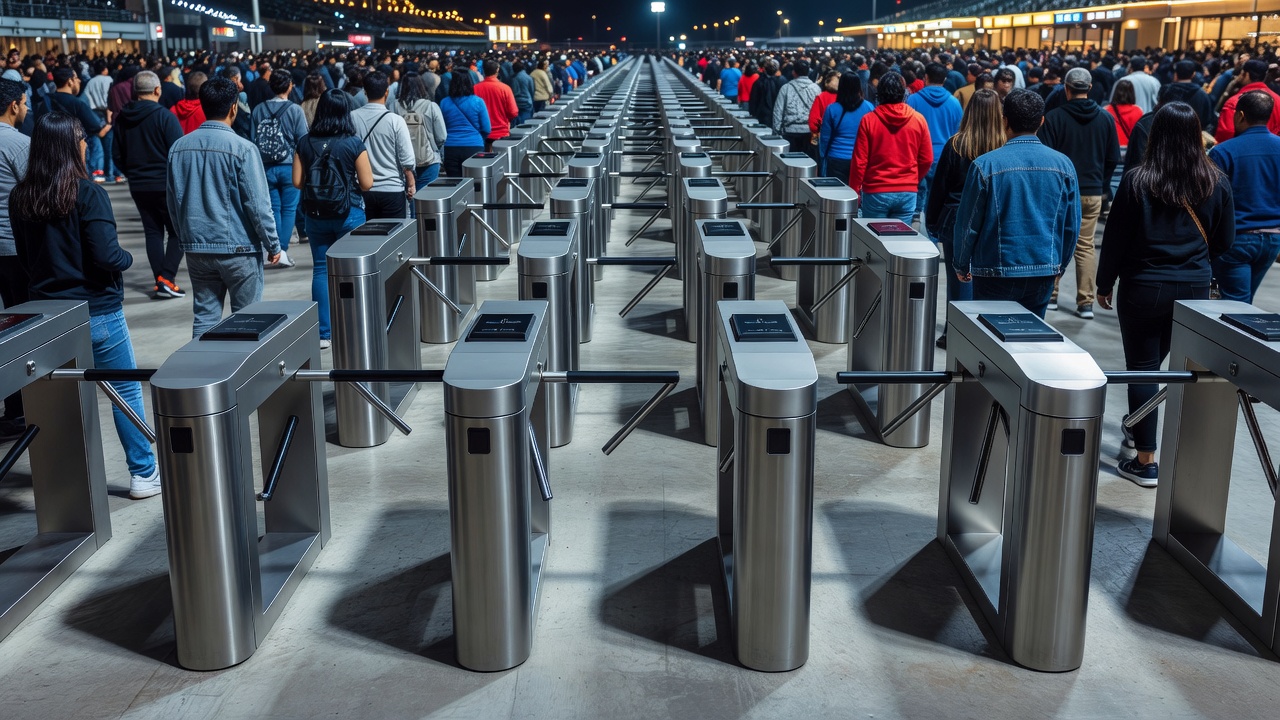
Plan the whole arrival sequence
An entrance is more than a line of turnstiles. Visitors approach from streets, transport stops and car parks; they look for signs, find the right gate, join a queue, pass any required checks and orient themselves once inside. Each transition can create hesitation or counterflow. A plan that calculates only scanner speed can overlook a blocked walkway, a family rejoining a group or a visitor who needs a step-free alternative.
Begin with arrival assumptions: expected attendance, likely arrival curve, ticket types, event opening times, transport patterns and weather exposure. These are planning inputs, not predictions with certainty. A concert crowd may arrive in a sharper wave than a match audience; a delay to public transport can bunch arrivals even when the forecast is gradual. Capture the assumptions and the person responsible for updating them. Where possible, compare plans with actual arrival observations from previous events, while noting differences in event type and conditions.
Compare entrance arrangements by pressure point
Dedicated lanes
Separating access types can simplify wayfinding. Poorly balanced lanes may leave one queue long while another has spare capacity.
Flexible lanes
A reassignable line can respond to demand. It needs clear signs, trained staff and a way to preserve accessible access.
Distributed checks
Moving checks upstream may spread activity. It can also create a second queue that needs space and supervision.
For any arrangement, ask where people wait, where they merge and where a queue can expand without crossing an exit path, public footway or emergency access. Mark a queue boundary that staff can recognize and a point at which a steward escalates spillback. Do not assume barriers alone will create orderly behaviour: their shape, gaps and staff presence influence how people join, leave and cross a queue.
Estimate throughput without promising it
Throughput is affected by the slowest part of the process. Ticket scanning may be quick when a code works, but exception handling, bag checks, searches or unfamiliar tickets can take longer. Estimate service rates using observations appropriate to the venue and task, then apply a cautious range rather than a single ideal figure. Include the time needed to recover from a device fault, verify a ticket manually or open an additional lane. A planned capacity is not a guaranteed output.
Keep a distinction between people waiting outside, people being processed and people admitted. Counts taken at a gate can be useful, yet they do not show the queue’s physical footprint or the conditions of the surrounding area. A steward report that a line is obstructing a crossing may matter more urgently than a throughput figure that appears on target. Pair numbers with field checks and define who can change the arrangement.
Make access understandable
Wayfinding should be visible before visitors reach the queue. Use consistent gate names, large readable signs and repeated confirmation at decision points. Digital tickets and pre-event messages can clarify which entrance to use, what checks to expect and where accessible services are located. Plan for visitors with mobility, sensory or communication needs without making access depend on improvisation at the busiest point. Staff should know how to direct a visitor to a suitable route without sending them against the flow.
Entrance operations also need a clear escalation path. A gate supervisor should know how to report a scanner failure, suspicious item, medical concern, queue encroachment or mismatch between expected and observed arrivals. Agree how the control room responds and how adjacent gates are informed. When opening or closing a lane changes the pedestrian layout, check the consequences beyond that gate: a change may shift pressure to the next junction.
Rehearse and review
Before doors open, confirm staffing, radios, barriers, signage, lighting, ticketing equipment, accessible alternatives and fallback procedures. A walk-through should follow the visitor’s journey from approach to the first internal destination. Test what happens when a line reaches its boundary and when two arrivals streams meet. During an event, review conditions at a cadence that suits the event, and communicate specific locations rather than vague alerts such as “gate busy.” Afterward, record queue length or extent, delay, exceptions, interventions and feedback. Use that record to refine assumptions rather than treating one event as a universal template.
References: UK Health and Safety Executive, Managing crowds safely; FIFA, Stadium Safety and Security Regulations; ISO 22320:2018. Check venue-specific arrangements and applicable requirements before operational use.