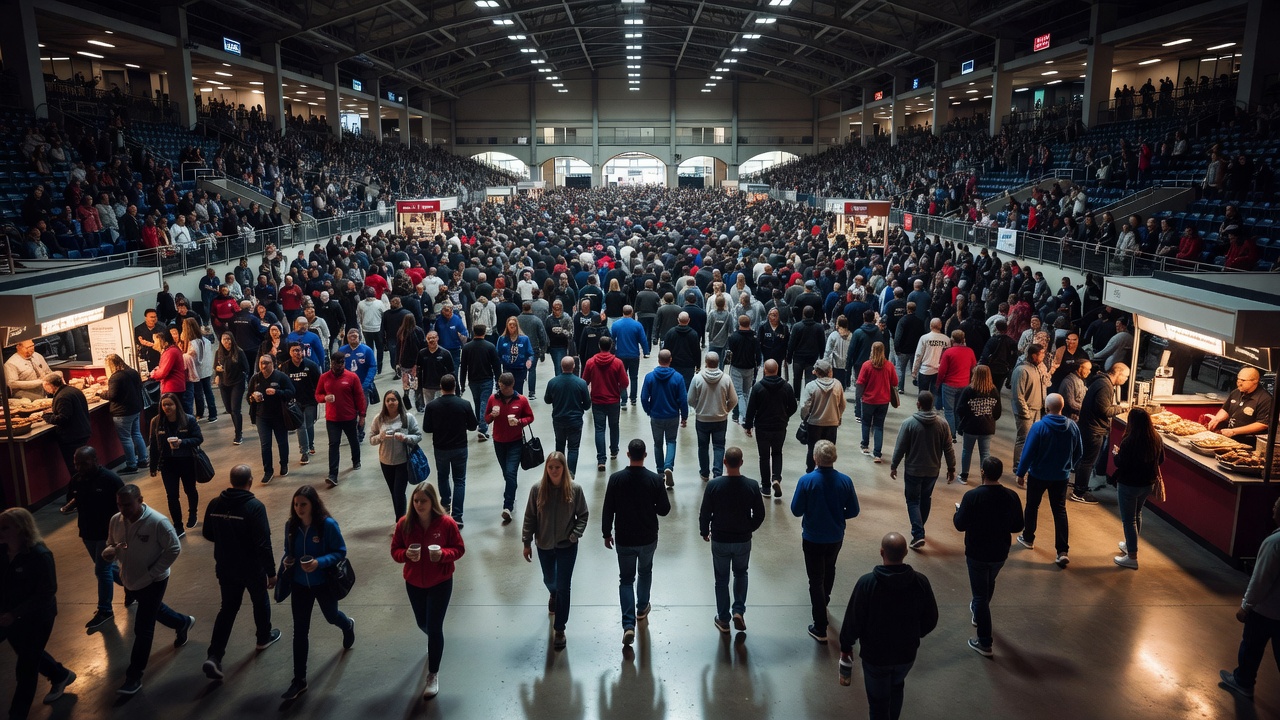
Start with the question, not the sensor
Occupancy sensing is often discussed as if a venue simply needs a single accurate number. In practice, teams need to answer narrower questions: Is a particular concourse getting busier? Has a queue reached a crossing? Is movement slowing near a doorway? Does the activity reported by a device agree with what a steward sees? A useful system is designed around these decisions, not around a dashboard full of undifferentiated totals.
Different technologies observe different things. A camera-based system may count crossings or classify movement within a selected view. A thermal or infrared counter can register passage without producing conventional imagery. Wi-Fi and Bluetooth analytics may infer patterns from device signals, but not every person carries a detectable device, and one person may carry several. Pressure, beam and turnstile counters can record a passage at a defined point but do not necessarily establish where someone goes next. None of these measurements should automatically be treated as a complete count of every person in a space.
Operators should distinguish three layers. An observation is the direct output reported by a device: for example, a counter registering a crossing. An estimate uses that output, a model and assumptions to infer occupancy or direction. An operational decision is a human choice—perhaps to check a junction, open an alternative route or pause an inflow. Keeping these layers separate makes it easier to explain what is known, what is inferred and who is responsible for acting.
Build a map with meaningful boundaries
A sensor has a field of view, coverage area, sampling interval and known blind spots. Map those against the places that matter operationally: entry lanes, queue holding areas, concourse junctions, stairs, accessible routes and exits. A whole-building average can conceal a local pinch point. Conversely, a temporary cluster may be harmless if there is room to disperse and no crossing is blocked. Define zones around operational questions and document their edges so teams do not compare unlike measurements.
Counts at boundaries can help identify flow. If a reliable counter records people entering a zone and another records departures, a system may estimate how the zone’s occupancy changes over time. But missed detections, unobserved entrances, sensor drift and latency accumulate. A counter that is correct most of the time can still produce a misleading total after repeated movement, especially if the system assumes that every route is covered. Periodic checks against manual observations help reveal drift; the checks themselves should record time, location and conditions rather than being treated as universal ground truth.
Choose signals with care
For each measurement, record what the sensor detects, the time window, the expected update delay, the confidence or quality indicator, and the person who can investigate a discrepancy. A display should make stale data visible. It should also identify whether values are measured, inferred, manually entered or carried forward from an earlier interval. Use plain operational language; a precise-looking decimal does not make an estimate exact.
Privacy deserves attention during system design. Collect only what is needed for a defined operational purpose, limit access, establish retention periods and consider whether aggregate counting can meet the need without identifying individuals. Camera analytics, device-based tracking and stored footage have different implications. Explain the chosen approach to staff and visitors in accessible terms and follow applicable data-protection requirements. A safety objective does not remove the need for proportionate data practices.
Translate a signal into a decision
Agree in advance what a change in the display means for the response. A threshold may prompt a steward to verify conditions, but it should not mechanically declare a space safe or unsafe. Include context: event phase, queue geometry, mobility needs, weather exposure, competing flows and the reliability of the sensor. If reports disagree, name who checks in person and who has authority to pause, redirect or reopen movement. A short closed-loop message—observation, location, action, confirmation—can be more useful than a complex automated alert without an owner.
Test the complete chain before event day. Confirm timestamps, map labels, connectivity, backup procedures and the way uncertainty is displayed. Rehearse a missing feed and a false alert. During the event, compare selected signals with steward observations and keep a record of interventions. Afterwards, review whether the measurement changed a decision, whether it arrived in time, and what conditions made it unreliable. The goal is not a perfect picture. It is a more accountable picture that supports timely human oversight.
References: UK Health and Safety Executive, Managing crowds safely; FIFA, Stadium Safety and Security Regulations; ISO 22320:2018, Security and resilience—Emergency management. These sources inform general practice; this page is not a venue-specific compliance assessment.